Something good is coming. Fable Social Tonics available late October.
Something good is coming. Fable Social Tonics available late October.
Something good is coming. Fable Social Tonics available late October.
Something good is coming. Fable Social Tonics available late October.
Something good is coming. Fable Social Tonics available late October.
Something good is coming. Fable Social Tonics available late October.
Something good is coming. Fable Social Tonics available late October.


Why Non-Alcoholic Drinks Cost as Much as Alcohol

At Fable, we pride ourselves on being transparent about what goes into our drinks, why it’s there, and what it costs.
So let’s take apart the price of a can of Fable and show you where the money goes. Hopefully we can teach you something about the strange economics of a CPG business along the way.
First, the assumption almost everyone brings to the shelf: take the alcohol out, and the price should come down with it.
It’s a fair assumption. It’s also mostly wrong, and the reason why tells you a lot about how the non-alcoholic drinks category actually works.
The alcohol was never the expensive part
The alcohol itself represents a surprisingly small part of what it costs to put most alcoholic drinks on a shelf.
Take it away and you’re still left with the same can, the same factory, the same warehouse, the same truck, the same retailer and many of the same costs involved in getting a drink into your hand.
What changes is what the brand decides to put inside the can instead. That choice matters more than most people realize.
No alcohol, same road
A drink generally has two ways to reach you. Through a distributor and retailer, or directly from us to your door. Neither route is particularly cheap.
In a store, a distributor moves it and a retailer puts it on the shelf, and both need to make money for doing so. Online, there may be no distributor or store, but there’s still a box, a warehouse pick, payment processing and a courier carrying twelve cans of liquid across the country.
Sparkling water weighs roughly the same as beer. Sadly, FedEx doesn’t offer a discount because there’s no alcohol inside.
“A consumer really isn’t just paying for what’s in the can. They’re paying for the road it takes to reach them.”
— Ben Kennedy, Founder & CEO
We put the cost in the can
We can’t make the truck dramatically cheaper. We can decide what goes into the drink.
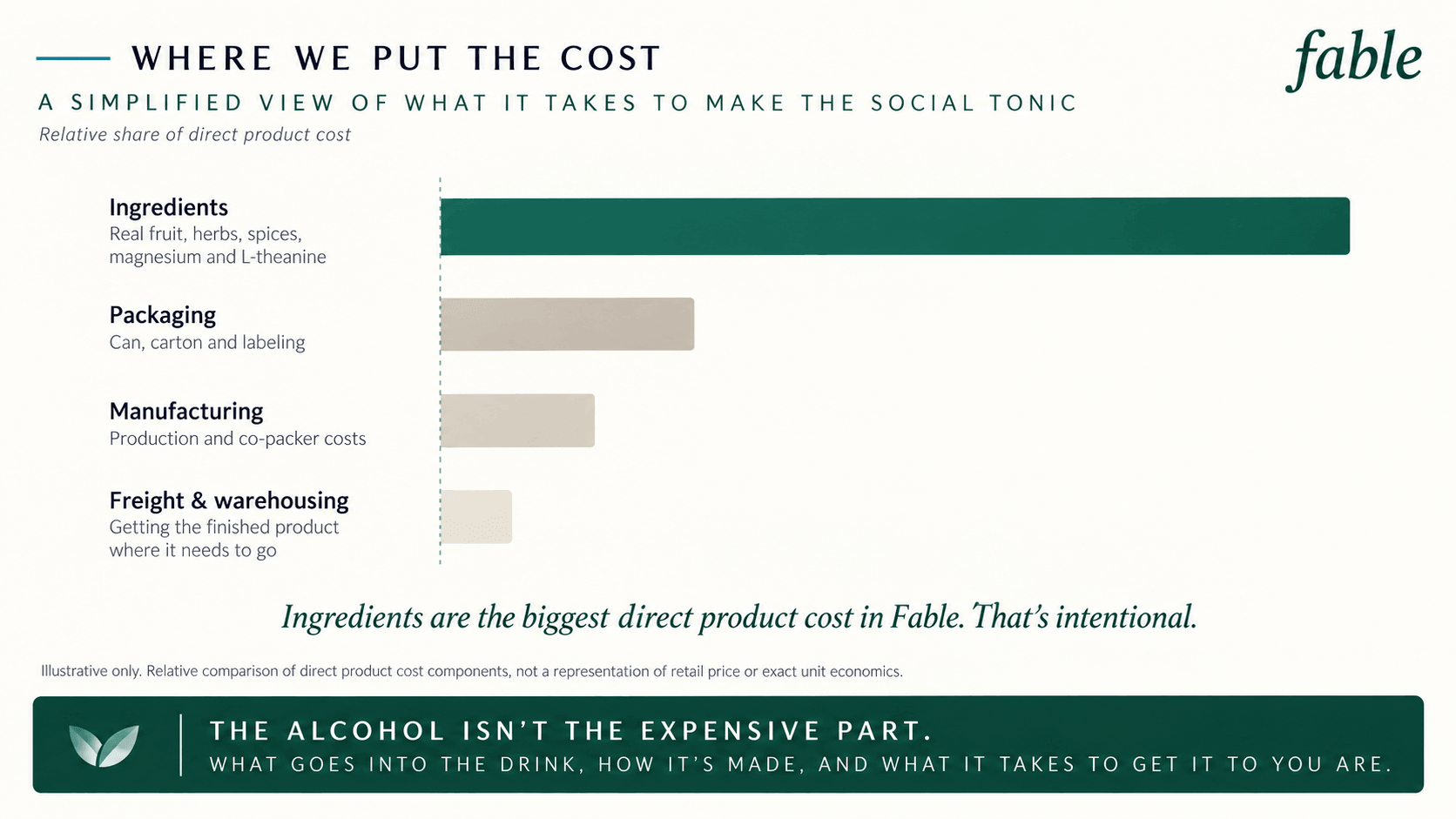
Only part of what you pay for a can of The Social Tonic is the liquid itself. The rest is everything required to manufacture it, package it and get it into your hands.
What isn’t the same between drinks is how much a brand chooses to spend on the recipe.
Inside ours, ingredients are the largest line in the cost of making the product. Larger than the can itself. Larger than the factory cost of filling it.
We’d rather you paid for the drink than the tin it comes in.
Where cheaper drinks find the savings
When a beverage brand needs its drink to cost less to make, there are only so many places to look. Packaging can be optimized. Manufacturing usually becomes more efficient with scale. Freight can improve as volumes increase. But eventually you arrive at the recipe.
And ingredients are one of the few places where you can make a meaningful difference to the cost of every single can. That doesn’t mean cheaper drinks are bad drinks. It means different brands make different choices.
A simple flavored sparkling water is relatively inexpensive to produce. A drink made with real fruit, herbs, spices and botanicals costs more. Add meaningful amounts of ingredients such as magnesium and L-theanine and the cost moves again.
We learned this particularly quickly while building our own DTC model. A case of sparkling drinks is heavy, and shipping heavy liquid to someone’s door costs more than most consumers probably realize.
The math forces choices. Ours was to protect the recipe.
Fable uses real fruit juices, herbs and spices, with 200mg of magnesium and 200mg of L-theanine in every can. We could build a cheaper drink. We just wouldn’t be building the drink we set out to make.
Why this matters in non-alcoholic drinks
For a long time, alcohol gave a drink an easy justification for being expensive.
Wine could cost $15, $30 or $100 a bottle and nobody expected the price to correlate directly with the amount of alcohol inside it. You were paying for ingredients, production, craft, provenance, distribution, brand and the experience of drinking it.
Non-alcoholic drinks deserve the same logic.
Removing alcohol doesn’t mean removing complexity. It doesn’t make real ingredients cheaper. It doesn’t make a case lighter. It doesn’t make the people producing, warehousing or delivering it work for free. A good drink still costs money to make.
So why does it cost the same?
Because the alcohol was never most of the cost. The can still has to be made. The drink still has to be produced. The case still needs to move through a warehouse, onto a truck, into a store or across the country to your front door.
And then there’s the thing we care about most. What’s actually inside it.
We don’t think the promise of non-alcoholic drinks should be that they’re cheaper than alcohol. The promise should be simpler.
Whatever you pay for the can, the drink inside should be worth it.
We think ours is. That’s the whole pitch.
Want to see why we keep choosing the harder route when it comes to ingredients and production? Read Nobody Asked for a Worse Drink.