Something good is coming. Fable Social Tonics available late October.
Something good is coming. Fable Social Tonics available late October.
Something good is coming. Fable Social Tonics available late October.
Something good is coming. Fable Social Tonics available late October.
Something good is coming. Fable Social Tonics available late October.
Something good is coming. Fable Social Tonics available late October.
Something good is coming. Fable Social Tonics available late October.

Why Is Non-Alcoholic Still Missing From the Tap Wall?

Picture the bar at a good restaurant. Twelve tap handles, gleaming. Stella. A local IPA. A cider. A nitro stout. Maybe a cold brew.
Now ask for something without alcohol.
You get a can from the fridge, or a soda water with a wedge of lime and an apology. The one part of the bar that’s built for theatre, the part everyone looks at first, has almost nothing on it for the growing number of people who aren’t drinking.
The tap wall might be the last place in hospitality where non-alcoholic barely exists.
Who’s winning on draft
Almost nobody, and the brands making progress are telling you exactly why it’s hard.
Athletic Brewing started delivering kegs in 2023, hand-carrying the first ones to three bars in Brooklyn. By the start of 2025, they’d poured for something like 150,000 people on tap across a few dozen markets. That’s one of the most successful NA draft programs in the country, and their CEO still calls draft NA “a really tough sell,” because most operators aren’t ready to give up a line unless they know the demand is there.
Guinness took a different route. Rather than relying entirely on traditional draft, they engineered much of the draught experience into the can with a nitrogen widget. In Ireland, some pubs have also installed single-can micro-draught systems to pull a proper pint of Guinness 0. They didn’t simply fight for space on the existing tap wall. They found another way to recreate the ritual.
Then there’s the quieter category that rarely gets counted as NA draft at all. Kombucha, cold brew, ginger beer and house cocktails have been coming out of taps at breweries, cafés and bars for years. The equipment works. Guests order them. Operators already know how to serve drinks other than beer from a keg.
What’s largely been missing is a branded, adult, non-alcoholic drink that genuinely belongs on the wall next to the beer.
Why beer owns the tap, and why most NA drinks don’t
There’s a reason the tap wall is dominated by beer rather than sparkling water.
Draft rewards drinks that have something to reveal. Think about that Guinness we mentioned earlier.
Poured cold through a clean line, beer gives you a proper head, rising aroma and flavors that continue to open as the drink warms. The pour is part of the experience.
Draft is a stage. It amplifies whatever you put on it.
Put something thin or one-dimensional on that stage and there isn’t much to amplify. If the first sip tastes exactly like the last, and the drink is essentially the same from a can as it is from a glass, draft adds cost without adding much experience.
That’s the important distinction.
Why a flavor arc is built for the keg
The Social Tonic was formulated by a Culinary Institute of America graduate to do the opposite.
Fable has mouthfeel, viscosity and a flavor arc that moves across the palate more like a glass of wine than a flavored seltzer. A bright opening note. A botanical middle. A finish that lingers. Fresh color from real ingredients.
Those characteristics give draft something to work with.
Temperature. A Social Tonic poured cold into a chilled glass starts crisp and clean, then changes subtly as it warms. Aromatics open up. Different notes become more noticeable. That progression is a feature, not a flaw. It’s the same reason a good wine bar doesn’t serve every bottle ice-cold.
Carbonation. Draft gives the operator greater control over the serve. A botanical drink can benefit from a finer, tighter bead rather than aggressive seltzer-style carbonation. The bubbles should support the drink, not dominate it.
The glass. A proper pour, a garnish, a stem or a rocks glass changes the context. In a restaurant or bar, it makes the drink part of the hospitality experience rather than something retrieved from the back fridge.
For the guest who isn’t drinking, that distinction matters.
In a can, you taste the drink. On draft, you get the pour, the glass, the aroma and the way the drink develops while you’re sitting at the bar.
The tap handle helps educate
From our perspective, here’s the part that isn’t really about the liquid at all.
A tap handle is some of the most valuable real estate in a bar. It’s at eye level, usually well lit, and guests read the row before they order.
Stella doesn’t own space behind the bar purely because of what’s inside the keg. The chalice, the handle and the ritual of the pour are all part of the experience.
We want that same sense of choice for the guest who isn’t drinking.
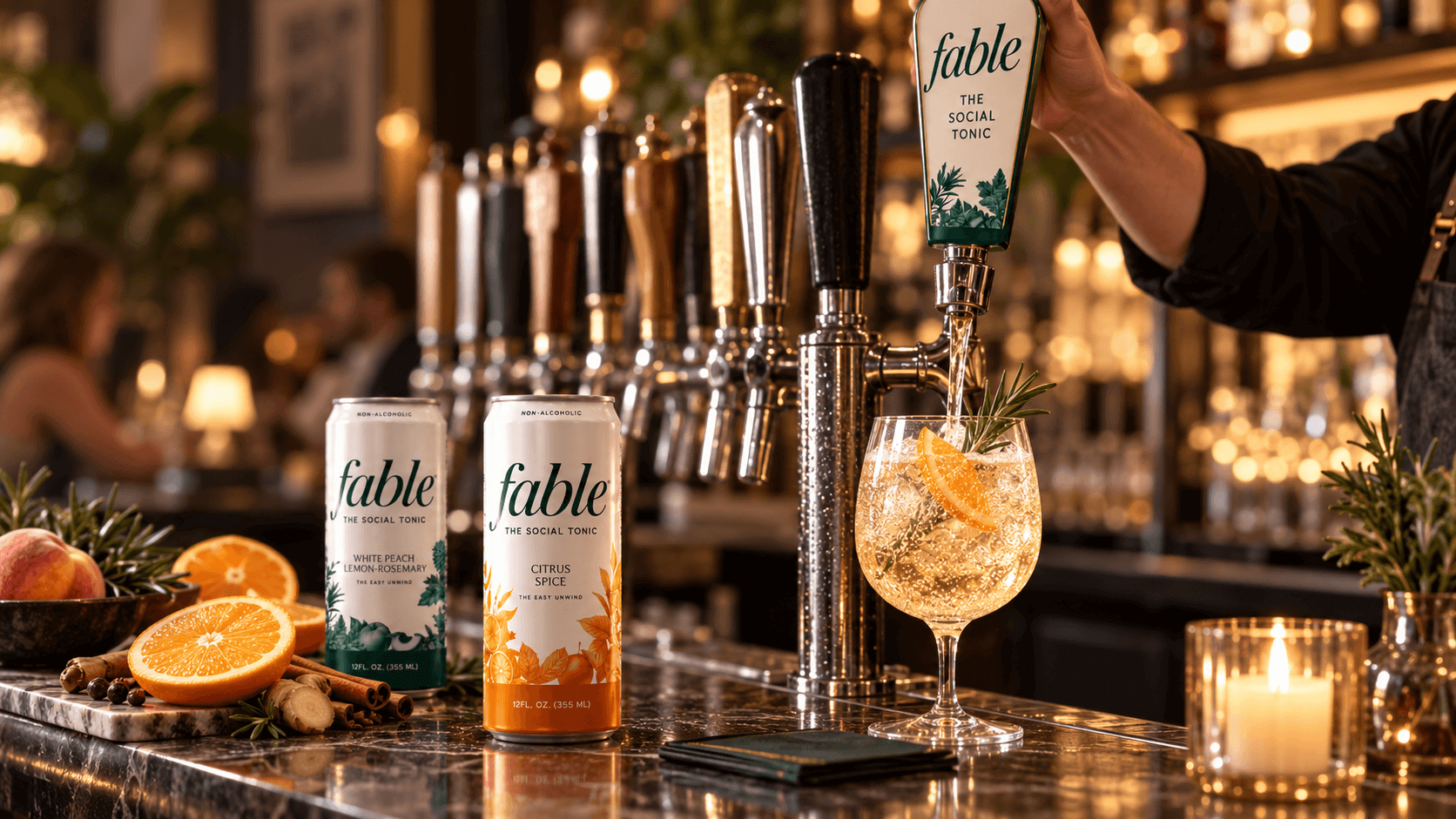
A handle that says The Social Tonic, sitting between the IPA and the lager, changes the conversation. Suddenly the non-alcoholic option isn’t hidden at the bottom of the menu or sitting in a fridge somewhere.
It’s on the wall.
Where could you find The Social Tonic on draft?
Not everywhere.
Draft is a commitment for an operator, and it only makes sense when enough guests are looking for alternatives to alcohol.
The right restaurant, where the wine list is serious and the non-alcoholic page is still an afterthought. The event space, where a significant part of the room is driving or choosing not to drink. The hotel bar. The stadium concourse. The hospitality venues where the quality of the drink and the experience around it actually matter.
Those are the places where we think The Social Tonic belongs.
On a handle. Cold. In a proper glass. In the same places where a good drink has always mattered.
Nobody owns non-alcoholic draft yet.
We think somebody should.
Wondering why a good non-alcoholic drink can cost as much as the beer beside it? Read Why Non-Alcoholic Drinks Cost as Much as Alcohol.